The proposed Accokeek Center data center campus in Stafford County has emphasized that it would not use potable water for industrial cooling. That could significantly reduce the project’s direct demand on Stafford’s drinking-water system. But it does not eliminate the project’s broader water footprint.
If the campus ultimately uses its requested 122 megawatts of electricity, billions of kilowatt-hours would have to be generated over its lifetime—and producing that electricity can itself consume substantial quantities of water.
When Stafford residents hear concerns about data centers and water, the discussion usually focuses on cooling. That makes sense. Some data centers use substantial amounts of water to remove heat generated by servers.
Accokeek Center’s developers, however, have proposed a different approach. The project record includes restrictions on potable or groundwater use for industrial cooling and describes a closed-loop cooling system.
How much water is associated with generating the electricity that powers the data center?
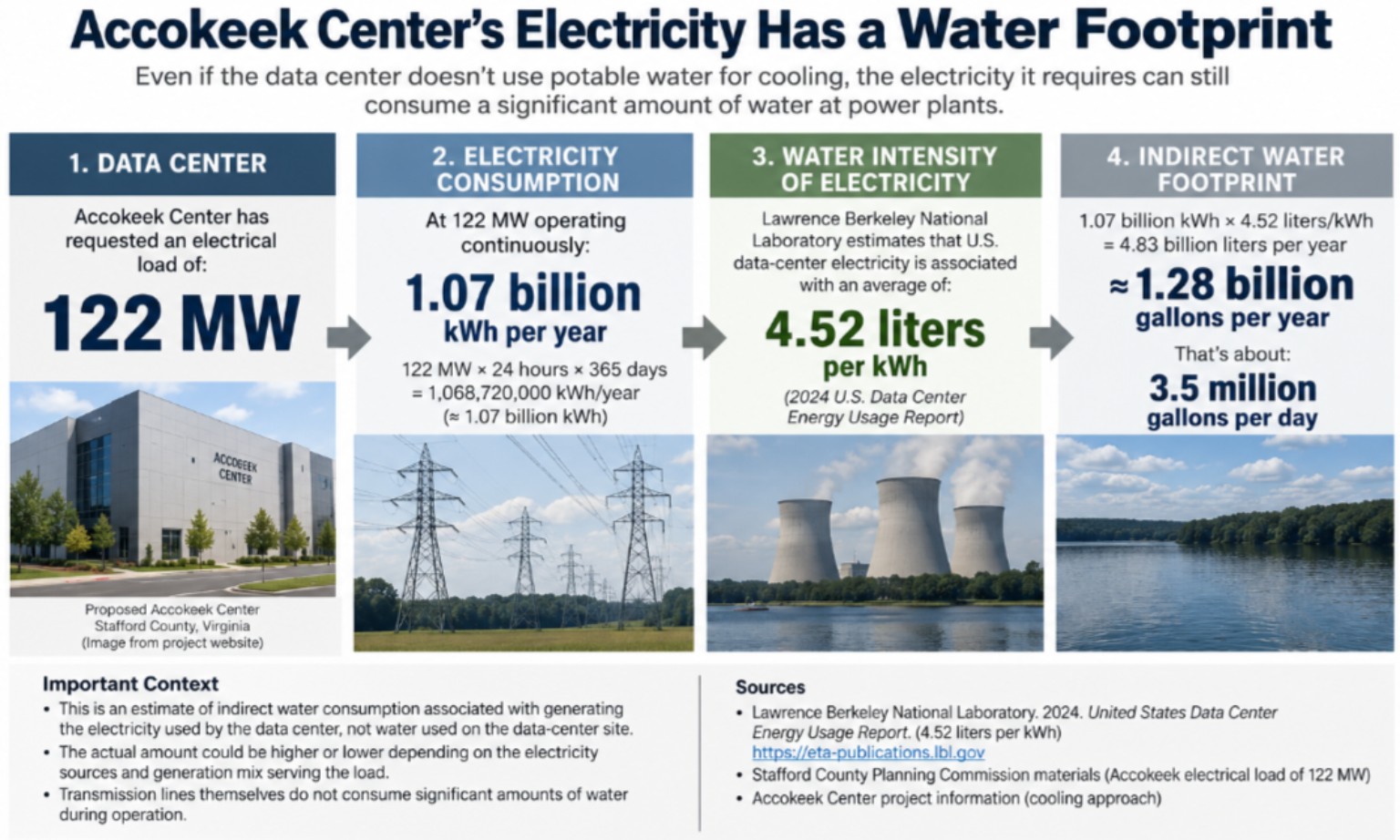
Accokeek has requested 122 megawatts
Stafford County planning information reported an electrical request of approximately 122 MW for the proposed Accokeek Center campus.
To understand the scale, assume for illustration that the completed campus eventually operated continuously at the full requested load:
That does not mean the facility will necessarily operate at 122 MW every hour of every year. The 122 MW figure is a requested electrical load, not a guarantee of constant consumption. Actual annual electricity use could be lower. The calculation is a full-load scenario used to show the scale involved.
Electricity has a water footprint
Power plants do more than consume fuel. Many also use water. Nuclear, natural-gas, coal and other thermal generating plants commonly use water in cooling and other portions of electricity production.
The U.S. Department of Energy’s Lawrence Berkeley National Laboratory examined this issue in its 2024 United States Data Center Energy Usage Report. For 2023, the researchers estimated that U.S. data-center electricity was associated with a national average of approximately 4.52 liters of indirect water consumption per kilowatt-hour.
This is fundamentally different from water flowing into the data center itself. It is water associated with generating the electricity used by the data center.
What would that mean for 122 MW?
Applying LBNL’s national benchmark to Accokeek’s full requested electrical load produces the following illustrative calculation:
Again, this does not mean Accokeek Center would consume 3.5 million gallons of Stafford County water every day. It means that if the facility operated continuously at its full requested 122 MW, applying LBNL’s national data-center electricity benchmark would produce an estimated electricity-related indirect water footprint of approximately 3.5 million gallons per day.
The water would generally be consumed where the electricity is generated—not necessarily in Stafford County.
Direct and indirect water are different questions
Water supplied to and consumed by the facility, including its cooling system.
Water consumed in producing the electricity delivered through the grid.
Accokeek Center’s proposed cooling approach addresses the first issue. It does not eliminate the second. That does not make the developer’s on-site water claim incorrect; it means the claim describes only one part of the facility’s total water footprint.
Where would Accokeek’s electricity actually come from?
This is where the calculation becomes more complicated. Electricity delivered through the grid does not come neatly labeled from one generating station. Stafford is within Dominion Energy Virginia’s service territory and the larger PJM regional transmission system. Electricity can be produced by nuclear, natural-gas, renewable and other resources, each with different water requirements.
Consequently, 1.28 billion gallons should not be presented as Accokeek Center’s actual future water consumption. It is a scenario produced by applying LBNL’s national average indirect-water benchmark to continuous operation at the project’s full requested electrical load.
The actual number could be considerably higher or lower depending on:
- How much electricity the completed campus actually consumes.
- The generating resources supplying the grid.
- The cooling technology used by those generating plants.
- Future additions and retirements of generation.
- Changes in Dominion and PJM’s generation mix.
Water withdrawal is even larger—but it is not the same thing
Water withdrawal and water consumption are not interchangeable. A power plant can withdraw enormous quantities of water from a river or other source for cooling and subsequently return much of it. Water consumption generally refers to water that is not returned to the immediate water source, often because it evaporates.
For that reason, extremely large power-plant withdrawal figures should not be described as water “used up” by a data center. Save Stafford uses consumptive water use for this comparison because it is the clearer measure of water removed from immediate availability.
The transmission lines do not consume the water
Transmission lines themselves do not require millions of gallons of water each day simply to move electricity. The recurring water footprint occurs primarily at the generation end of the system.
Transmission infrastructure sits between the generating resources and the customer. So when a large data center requests 122 MW, the infrastructure question is not limited to whether enough transmission capacity exists to deliver that electricity. It also includes what resources will generate it.
The bigger question for Stafford
Accokeek Center’s proposed cooling technology could substantially reduce one of the most visible environmental concerns associated with data centers. That deserves recognition.
But Stafford’s evaluation of a 122 MW data-center campus should not end at the property’s water meter. Before final approval, residents deserve clear answers about realistic electricity consumption, the generating resources expected to support the demand, the associated indirect water footprint, and any new generation, substations or transmission infrastructure that could ultimately be required.
When Stafford evaluates the environmental and infrastructure impacts of data centers, should it consider only what happens inside the property line—or the system required to keep those facilities operating?
Save Stafford’s position: Stafford County should evaluate the full infrastructure footprint of major data-center projects—not simply impacts occurring within project boundaries. Accokeek Center’s proposal to avoid potable water for industrial cooling is a meaningful improvement and should be recognized as such. But a 122 MW electrical request carries impacts beyond the site. Before approving projects of this scale, the County should require developers and utilities to provide residents with a clear picture of direct water demand, projected electricity consumption, generation requirements, transmission requirements and indirect resource impacts. Responsible growth requires understanding the entire system—not just what happens inside the fence.
Sources, documents & image credits
Read the original record
Lawrence Berkeley National Laboratory — 2024 United States Data Center Energy Usage ReportDecember 2024 · Open original source ↗Stafford County Planning and Zoning — Accokeek Center application recordApplication record reviewed September 6, 2026 · Open original source ↗Potomac Local — Planning Commission recommends Accokeek CenterSeptember 1, 2026 · Open original source ↗Stafford County Utilities — Reclaimed Water ProgramReviewed September 6, 2026 · Open original source ↗Support Save Stafford
Independent local information. No paywalls. No advertising.Research like this takes time and sometimes requires obtaining public records. Community support helps Save Stafford continue making this information freely available.
No subscription required. Contribute only if you choose. Financial contributions do not purchase editorial influence.