Stafford County is growing. Property values have risen. Development continues. Yet residents are paying a higher real-estate tax rate, County officials are warning that future budgets will remain difficult, and billions of dollars in infrastructure needs remain ahead.
So how did Stafford get here?
Save Stafford reviewed County budget documents, school financial records, Virginia education-funding formulas, debt information, tax-relief data, historic fiscal-impact studies, and projections for future commercial and data-center revenue.
The answer is not one bad expenditure, one tax increase, one Board of Supervisors, or one year. Stafford appears to be dealing with a structural financial problem that developed over many years.
And one of the solutions County leaders are increasingly counting on—massive data-center development—could produce substantial tax revenue while creating an entirely different set of costs and consequences for Stafford residents.
The budget problem in plain English
The pressure comes from several directions at once:
- Stafford remains heavily dependent on property taxes.
- Residential development has historically created substantial service and infrastructure costs.
- Commercial growth has not reduced that dependence enough to eliminate the pressure.
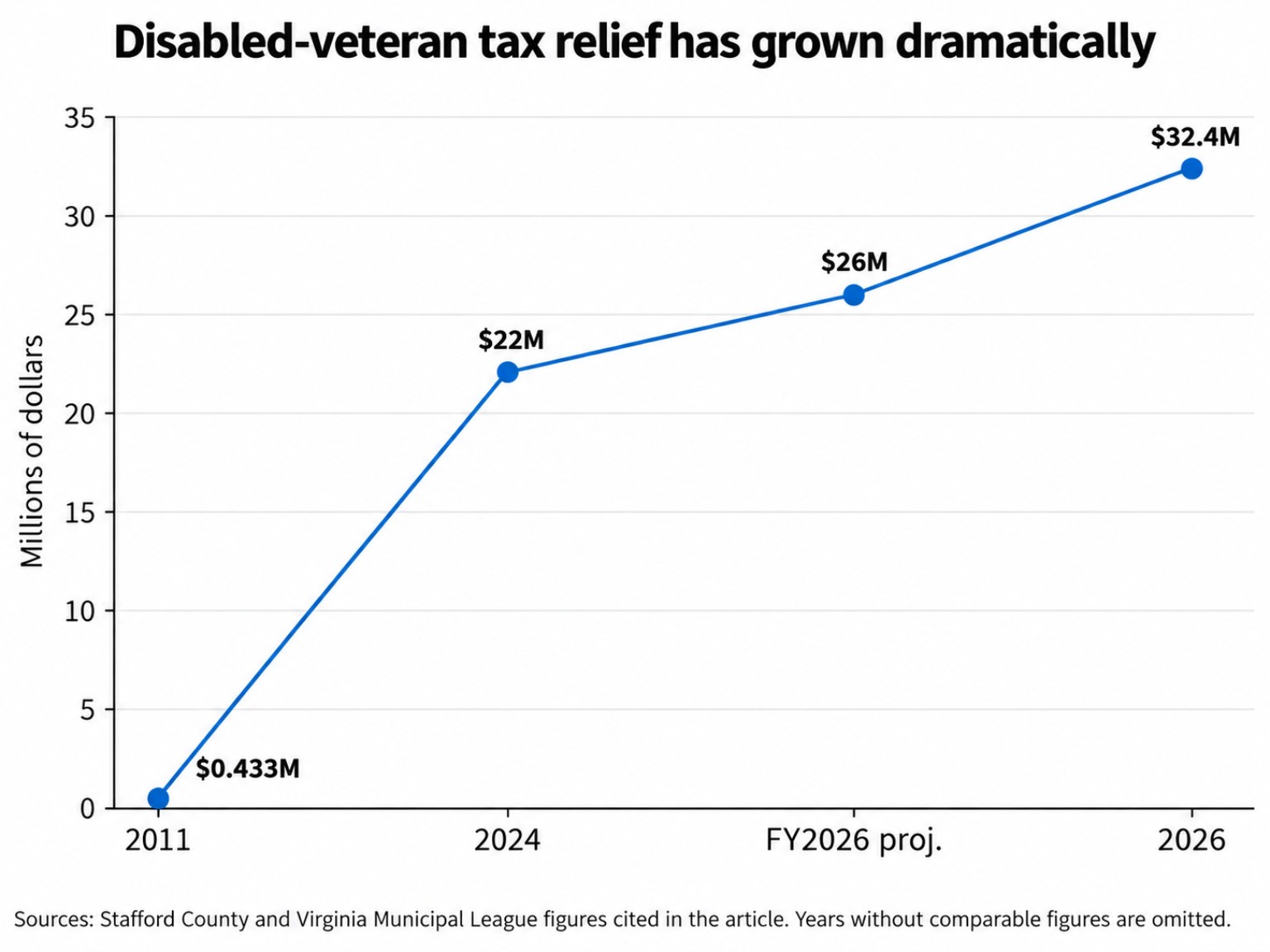
- State-mandated disabled-veteran property-tax exemptions have grown dramatically.
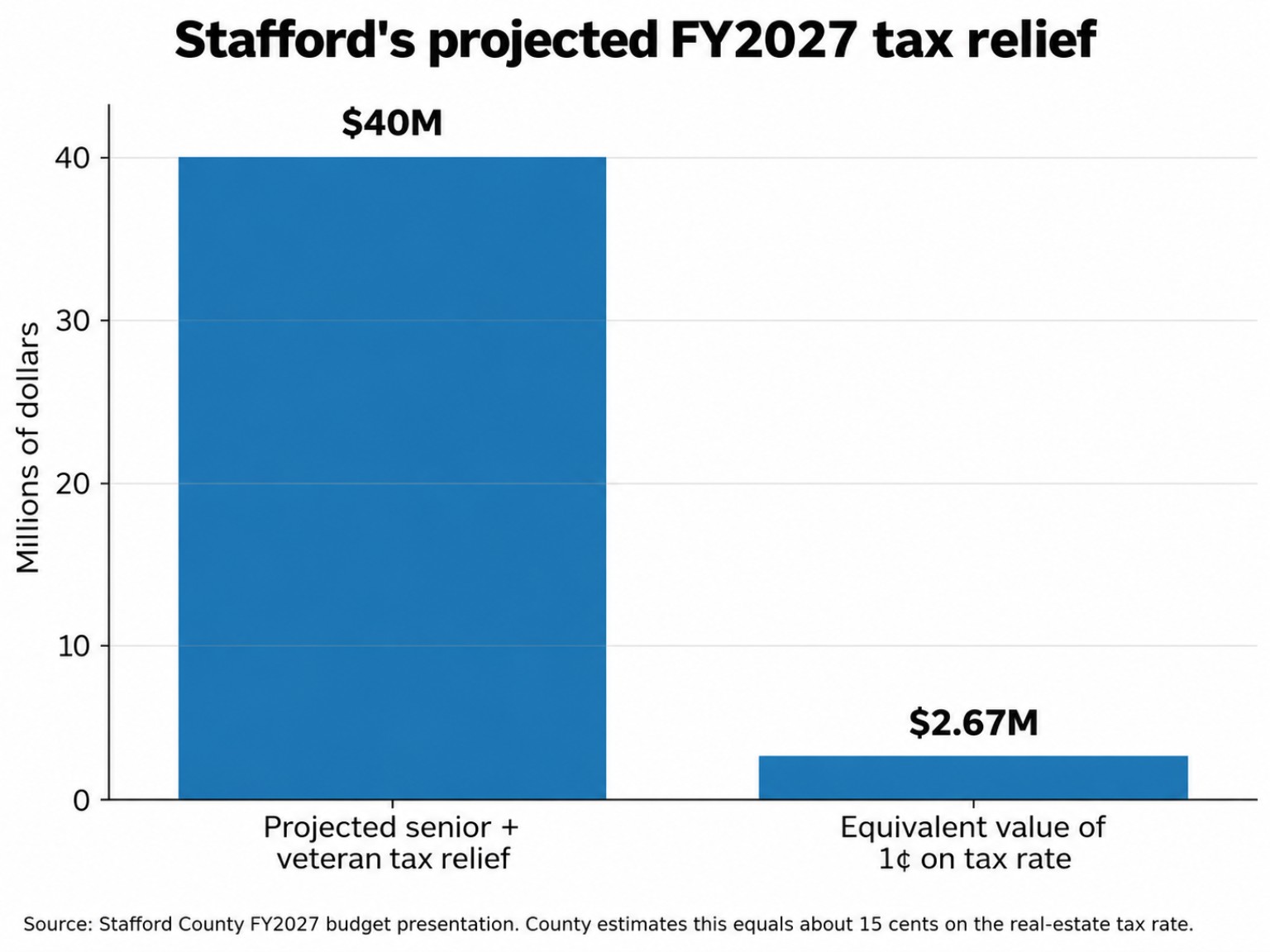
- Senior and veteran tax relief together are projected at approximately $40 million in FY2027.
- Virginia generally does not replace all of that lost local revenue.
- The state school-funding formula may overstate Stafford’s usable ability to pay.
- Stafford competes in the Northern Virginia labor market while receiving only part of certain regional school-funding adjustments.
- Three new schools created construction debt and recurring operating costs.
- School spending per student, public-safety costs, and other operating expenses have increased.
- Stafford still faces enormous future school and infrastructure requirements.
- Future commercial and data-center revenue has not yet fully arrived.
This is why the County can simultaneously be growing and still experience serious budget pressure.
Stafford needs a balanced fiscal strategy: state reimbursement and school-funding reform, development that proves its long-term value, diversified commercial growth, disciplined use of future data-center revenue, spending scrutiny, and transparent lifecycle accounting.
Stafford was warned more than 15 years ago
In 2010, George Mason University’s Center for Regional Analysis prepared a fiscal-impact study for Stafford County. It asked whether expected residential and commercial growth would generate enough revenue to pay for the public services that growth required.
Under the study’s assumptions, residential development generally generated less County revenue than the estimated cost of serving it. In 2009 dollars, the estimated annual impacts were:
Those figures are more than 15 years old and should not be applied directly to homes being built today. Property values, households, taxes, school expenses, staffing costs and County services have all changed. But the larger finding matters: maintaining an appropriate balance between residential and commercial growth was important to Stafford’s fiscal health.
More development does not automatically mean a stronger County budget. What gets developed matters.
A house produces taxes—but it also creates demand
A new home generates real-estate taxes and its residents contribute to the local economy. But residential development also creates demand for schools, teachers, buses, fire and rescue, sheriff services, roads, parks, libraries, courts, utilities, maintenance and public employees.
The right question is not simply, “How much tax revenue does this development generate?” It is: “How much revenue does it generate compared with what Stafford will spend serving it over decades?”
Stafford remains extremely dependent on property taxes
Approximately 69% of Stafford’s FY2027 General Fund revenue comes from property taxes of various types. When costs increase faster than other revenue streams, one of the County’s most powerful tools is also one of its least popular: the property-tax rate.
Then came extraordinary growth in tax exemptions
Virginia exempts the principal residence of qualifying permanently and totally disabled veterans from real-estate taxes. The benefit itself is not the central issue. Stafford has an unusually large military and veteran community, so the question is: Who should finance a benefit established through statewide policy?
The Virginia Municipal League reported that Stafford’s disabled-veteran exemptions reached approximately $32.4 million in 2026—about 10.1% of Stafford’s real-estate tax revenue and a 24.4% one-year increase.
Stafford’s FY2027 presentation estimates that senior and disabled-veteran tax relief combined will reach approximately $40 million, roughly equivalent to 15 cents on the real-estate tax rate.
Higher assessments do not automatically fix that
Increasing assessments generally increase the revenue a particular rate can generate. But more property is also becoming exempt. Stafford can have a larger total real-estate value while a growing portion of that value produces no normal real-estate tax.
Stafford may be getting hit twice
Virginia uses the Composite Index of Local Ability-to-Pay to divide education funding between the Commonwealth and localities. Stafford Schools has argued that the formula can produce a distorted result when tax-exempt property contributes to measured wealth even though Stafford cannot collect normal taxes from it.
If so, Stafford can lose the local tax revenue and receive less state education support than its usable taxable resources would justify. That should be a major legislative issue.
Stafford also competes in Northern Virginia
Stafford competes for teachers and employees in an expensive regional labor market. Virginia recognizes part of that challenge through its Cost of Competing Adjustment, but Stafford Schools has argued that the County receives only a portion of the adjustment available to some Northern Virginia jurisdictions.
Then Stafford built three schools
Hartwood High School, Falls Run Elementary School and Crow’s Nest Elementary School opened or were scheduled around 2026. They provide thousands of seats, but construction affects the budget twice: first through land, design, construction, equipment, financing and debt service; then through decades of staffing, utilities, maintenance, transportation, technology and security.
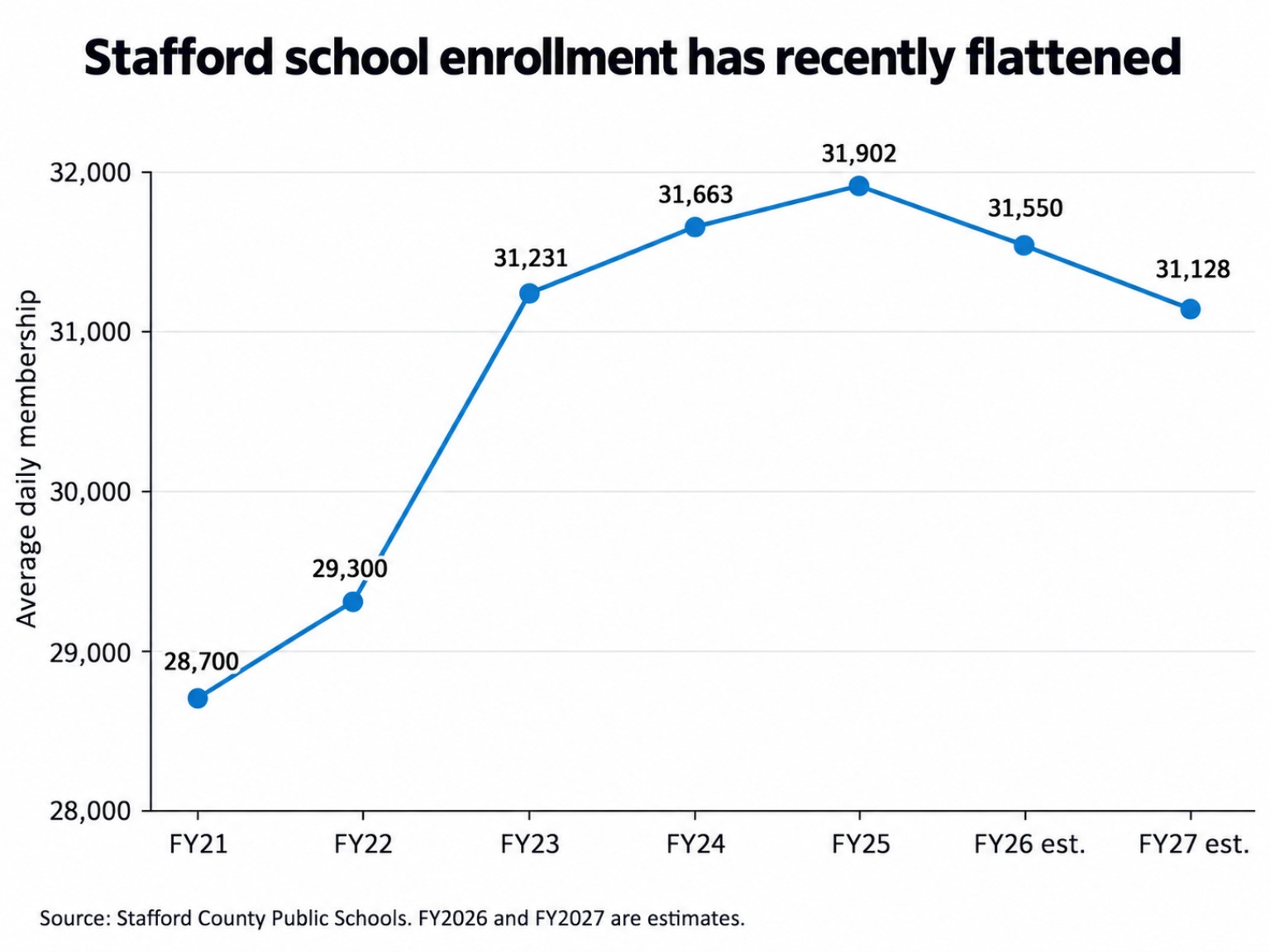
Yet enrollment is not exploding
Current estimates show fewer students in FY2027 than FY2025. That does not prove the new schools were unnecessary: individual schools can be overcrowded, population distribution changes, and older facilities may need replacement. But Stafford’s school financial problem cannot be reduced to “enrollment suddenly exploded.”
Spending per student has increased
Stafford Schools reports operating expenditures per student rising from approximately $11,216 in FY2021 to an estimated $17,410 in FY2027. That deserves examination, but the entire nominal increase should not automatically be labeled waste. Inflation, salaries, benefits, transportation, special education, technology and utilities all matter.
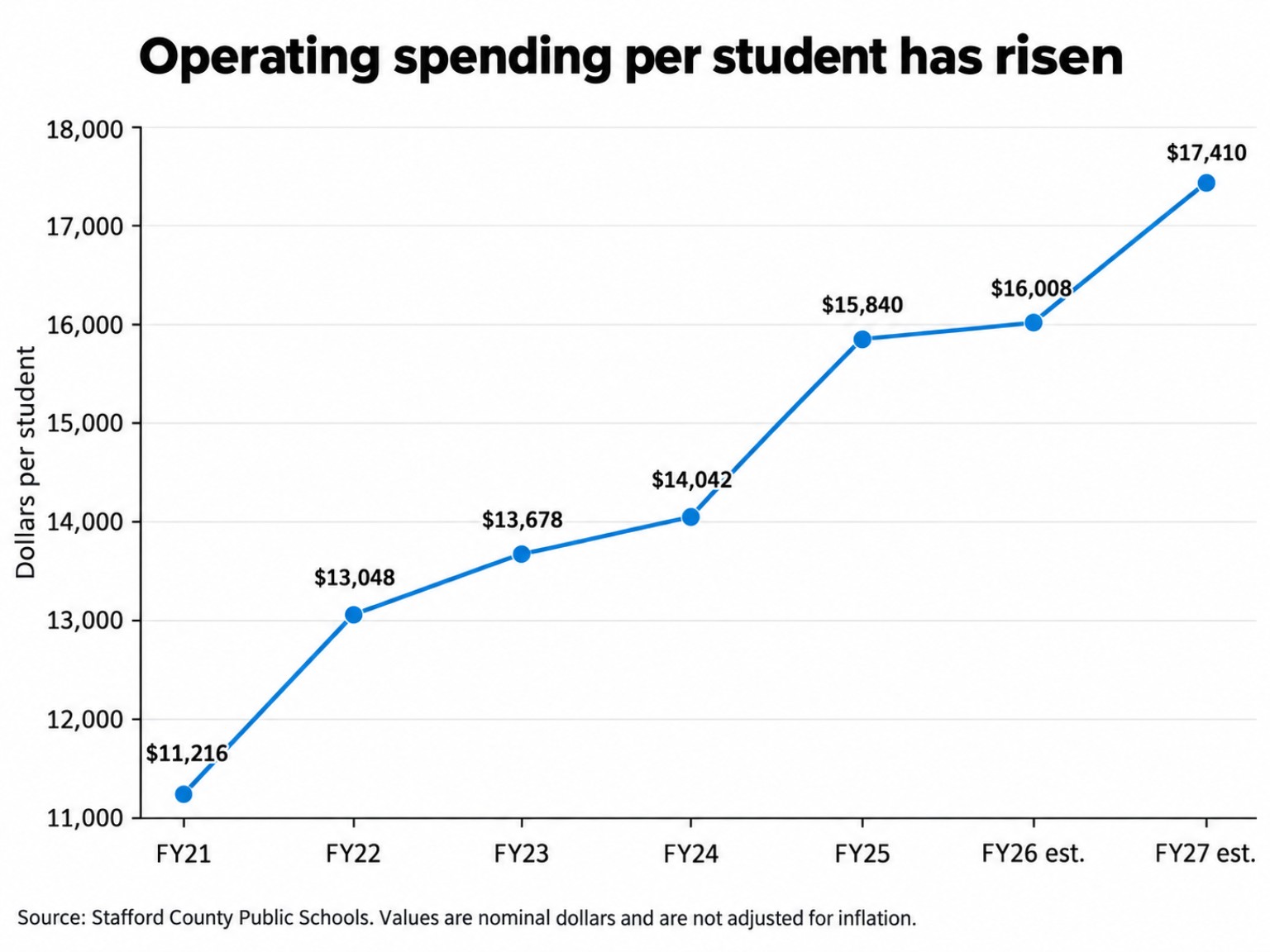
The correct question is: After accounting for inflation, enrollment, service changes and compensation requirements, has spending increased faster than reasonably necessary?
Stafford still faces enormous school capital needs
Stafford Schools has identified approximately $1.9 billion in future capital needs, including about $1.7 billion in major projects and $224.8 million in repairs, renovations and replacements. Those needs will compete directly with every other County priority.
But Stafford is not broke
Stafford maintains strong credit ratings and financial reserves. Recent financial statements have shown revenues meeting or exceeding projections and expenditures finishing below budget. The problem is not insolvency; it is a recurring operating-budget squeeze in which obligations consume an increasing share of recurring revenue.
This is why commercial development matters
Commercial and industrial development can produce substantial tax revenue while creating less demand for schools and some other public services than residential growth. That is why Stafford has spent years discussing diversification of the tax base—and why data centers are so attractive.
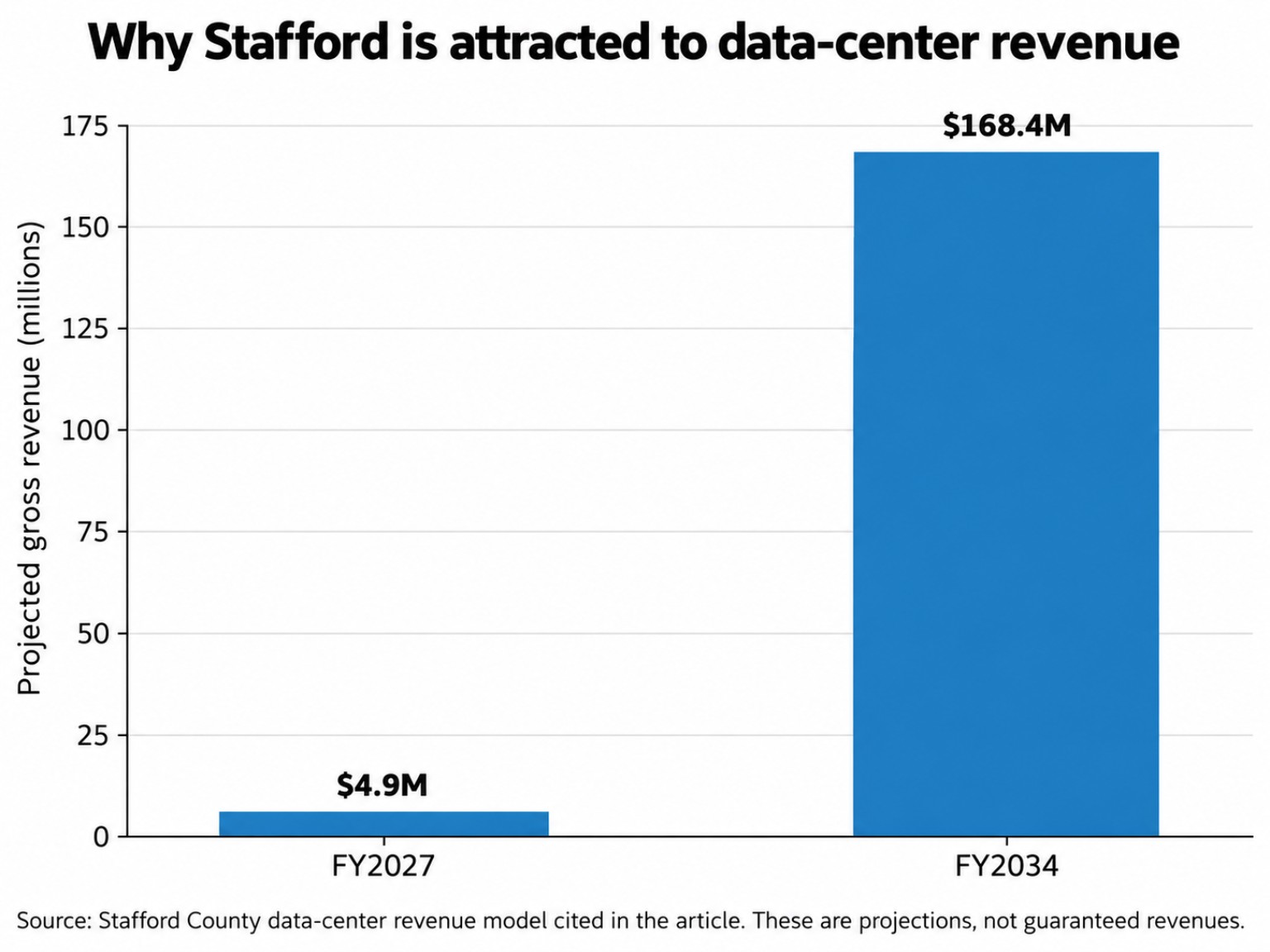
A County forecast involving five approved data-center campuses projected gross revenue of approximately $4.9 million in FY2027, potentially rising to $168.4 million annually by FY2034 under the model’s baseline assumptions.
Data-center tax revenue is not free money
Large campuses can require extensive land clearing, industrial buildings, substations, backup-generation infrastructure, transmission upgrades, roads, water or cooling infrastructure depending on design, and substantial electrical capacity.
Residents are also weighing forests, streams, wildlife habitat, noise, viewsheds, neighboring property, quality of life, and the transformation of rural or residential areas. A fiscal solution that creates environmental or community costs is still a policy tradeoff.
Then came the Kraken
The original North Anna–Thornburg–Bristers proposal contemplated roughly 70 miles of new 500-kV and 230-kV transmission infrastructure across multiple Virginia counties, including Stafford. Dominion has since divided it into two projects. The Stafford portion—Thornburg to Bristers—is expected to proceed through a separate State Corporation Commission filing planned for fall 2027.
Study corridors are not approved routes. That distinction does not erase the legitimate concern of families whose homes, schools or property appear near concepts being studied.
Towering Concerns estimated that 9,323 Stafford homes were within 1,000 feet of one or more studied route concepts. That is an advocacy-group estimate—not an independently verified SCC parcel count—and it does not mean 9,323 homes would be demolished or directly crossed.
In a Stafford public survey of 465 respondents, approximately 93% were very or somewhat unfavorable toward the project. The survey was not a scientific countywide poll, but it demonstrates the intensity of opposition among participating residents.
What about electric bills?
Dominion residential customers are already experiencing higher bills, but it would be inaccurate to say current increases are entirely caused by data centers. They involve generation, delivery, labor, maintenance, fuel, infrastructure and other costs.
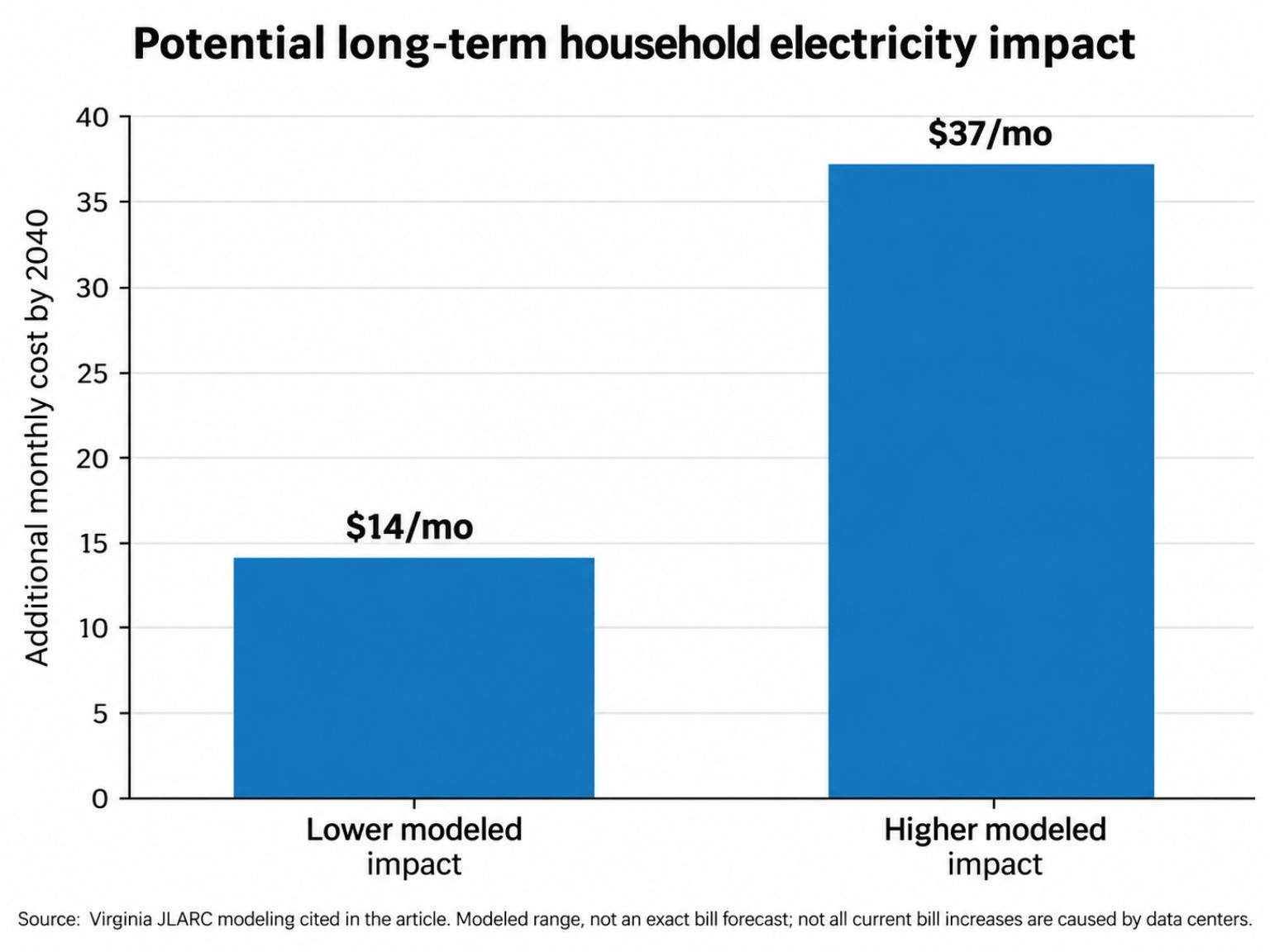
Virginia’s JLARC modeling found that rapid data-center electricity growth could eventually add approximately $14 to $37 per month in generation- and transmission-related costs for a typical Dominion residential customer by 2040, in real dollars and depending on the scenario. It is a modeled range, not an exact bill forecast.
Virginia regulators have responded by creating the GS-5 rate class for very large electricity users. Beginning in 2027, qualifying customers face minimum demand obligations intended to limit cost shifting onto other customers.
So are data centers the solution or the problem?
They can be part of the solution and part of Stafford’s next major challenge. They can expand the commercial tax base, support schools and public safety, and produce revenue without adding corresponding numbers of students. Their broader costs can include industrial land conversion, environmental impacts, substations, transmission corridors, effects on neighboring property and additional pressure on Virginia’s electrical system.
Stafford needs to account for community cost per dollar of revenue—not dollars per acre alone.
A 12-part plan to fix Stafford’s structural problem
1. Make Virginia help pay for Virginia’s mandates
Preserve the disabled-veteran benefit while creating a state reimbursement mechanism for localities where state-mandated exemptions consume a disproportionate share of the tax base.
2. Fix the school-funding formula
The Composite Index should reflect usable local fiscal capacity. Property Stafford cannot legally tax should not make the County appear more able to finance education than it is.
3. Address Northern Virginia labor costs
If Stafford faces Northern Virginia compensation pressures, state assistance should more accurately recognize those market conditions through a fairer Cost of Competing Adjustment.
4. Make development prove its fiscal value
Require transparent fiscal-impact analyses before major residential rezonings. Show annual revenue beside the long-term cost of schools, transportation, public safety, utilities, capital facilities, staffing and maintenance.
5. Connect development to infrastructure
Before major phases proceed, determine whether schools, roads, fire and rescue, utilities, and County finances can support the development.
6. Diversify commercial development
Pursue advanced manufacturing, technology, defense, research, healthcare, professional services, hotels, appropriate retail, offices and other high-value employers. Data centers can be part of the mix; they should not become the entire strategy.
7. Put environmental and community costs into the calculation
For major developments, disclose electric and water demand, potential transmission needs, land clearing, noise, environmental impacts, infrastructure requirements and effects on neighboring property.
8. Protect future data-center revenue
Establish a public policy before the money arrives that directs major new revenue toward property-tax relief, infrastructure, capital projects, debt reduction, schools, public safety and reserves.
9. Do not spend money before it exists
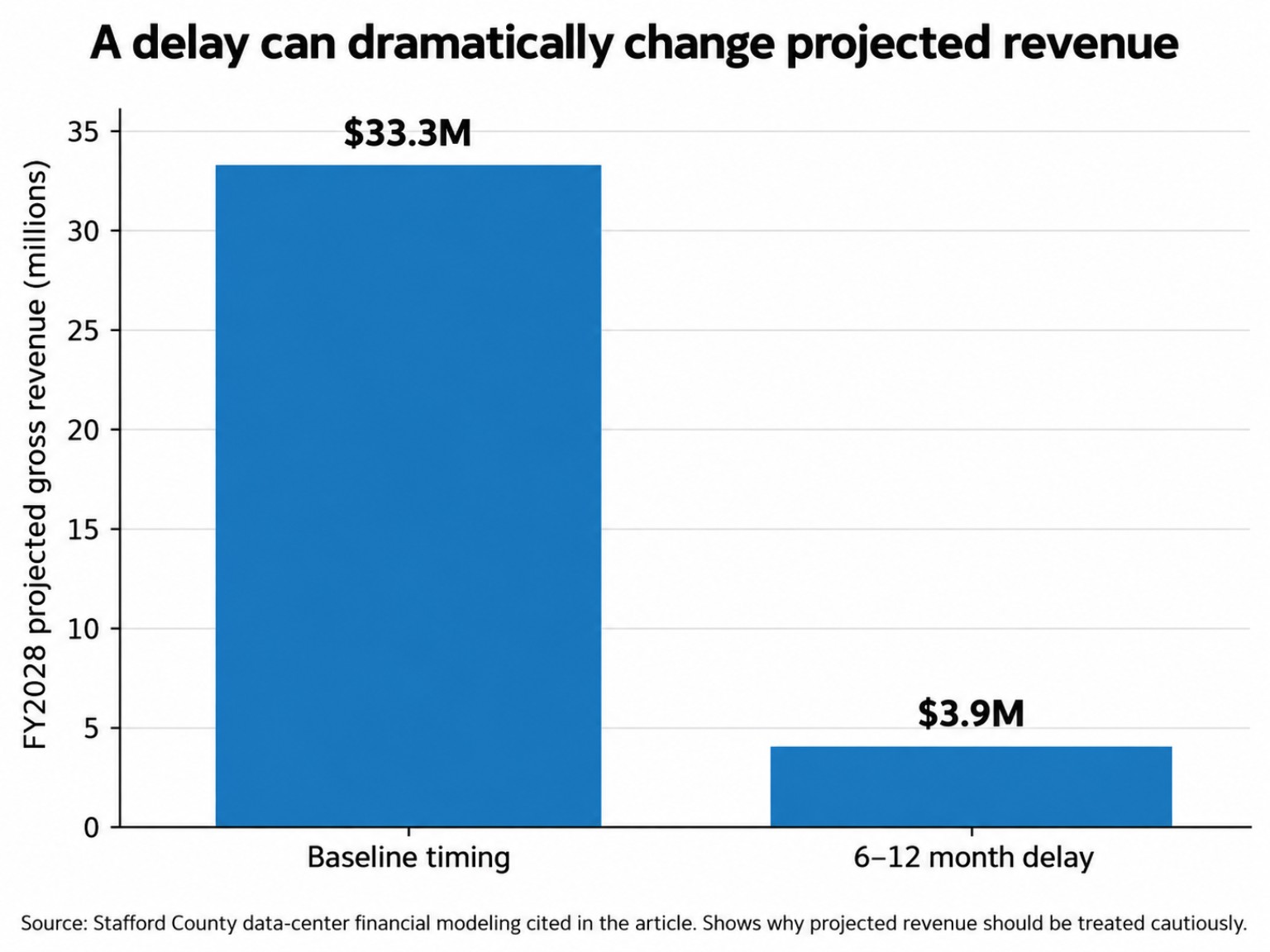
Construction can be delayed, power availability can change, and equipment investment can vary. Permanent recurring expenses should not be built on forecasts that have not become reliable revenue.
10. Scrutinize County spending too
Review administrative staffing, consultants, software, vehicles, overtime, procurement, capital projects, change orders, incentives, facilities, maintenance and duplicated services. The aim should be value, not arbitrary across-the-board cuts.
11. Show taxpayers where capital-project money goes
Publish accessible dashboards showing each project’s original estimate, design contract, construction contract, approved change orders, current cost, final cost, schedule and funding source.
12. Look beyond the construction price
Before approving a school, fire station, courthouse, park or government building, publish its lifecycle cost: construction, financing, personnel, utilities, maintenance, equipment, renovation and eventual replacement.
The most important lesson
Stafford’s current financial problem did not begin with the FY2027 tax rate. Rapid residential growth created revenue and expensive long-term obligations. Commercial development was expected to balance the equation. State-mandated exemptions then removed an increasing amount of property from the taxable base while school and infrastructure costs continued to grow.
Now Stafford is looking toward data centers and other commercial development to rebalance the system. But that creates a new question: How much of Stafford are residents willing to sacrifice to fix Stafford’s tax base?
The goal should not be “build more houses” or “build more data centers.” It should be:
Growth that produces more long-term public benefit than long-term public cost.
The bottom line
Stafford is not broke, but it does appear to have a structural financial challenge. The County remains heavily dependent on property taxes, has accumulated major infrastructure obligations, is absorbing rapidly growing state-mandated exemptions, and faces significant school operating and capital requirements. Some hoped-for commercial revenue remains years away.
There are solutions: state reimbursement, school-funding reform, fiscal-impact requirements, disciplined growth, spending scrutiny, capital transparency, commercial diversification, and careful use of future revenue.
Data centers may play a role, but residents should not be told that projected tax revenue comes without a price. Stafford’s next financial decision should not simply ask how much revenue can be generated. It should ask:
How do we build a financially sustainable Stafford without sacrificing the Stafford residents are trying to save?
More than 15 years ago, Stafford was warned that the type of growth it chose would determine whether growth strengthened or weakened the County financially. That warning still matters. Decisions made now may determine whether Stafford corrects that imbalance—or creates an entirely new one.
Sources, documents & image credits
Read the original record
Stafford County Budget and Capital Improvement ProgramFY2027 budget documents and presentation · Open original source ↗Stafford County Public Schools BudgetEnrollment, operating and capital information · Open original source ↗Virginia Department of Education Composite IndexLocal ability to pay methodology · Open original source ↗Virginia JLARC Data Centers in VirginiaElectricity demand, infrastructure and ratepayer modeling · Open original source ↗Dominion Energy North Anna to BristersCurrent project information and filing schedule · Open original source ↗Towering ConcernsCitizen route proximity analysis and community advocacy · Open original source ↗Compare the financial stage, linked public documents and outstanding verification gaps.
View financial record →Support Save Stafford
Independent local information. No paywalls. No advertising.Research like this takes time and sometimes requires obtaining public records. Community support helps Save Stafford continue making this information freely available.
No subscription required. Contribute only if you choose. Financial contributions do not purchase editorial influence.